Marine collagen: a healthy solution for your well-being

In our bodies, collagen is an important fundamental protein which ensures structure and theskin elasticitybones, tendons and joints. As we age, the production of endogenous collagen (synthesized by our bodies) naturally decreases, which can lead to the following symptoms Visible signs of agingThese include loss of skin firmness and joint pain. To offset this loss, collagen supplementation, particularly in the form of marine collagen, has become a popular and beneficial solution.

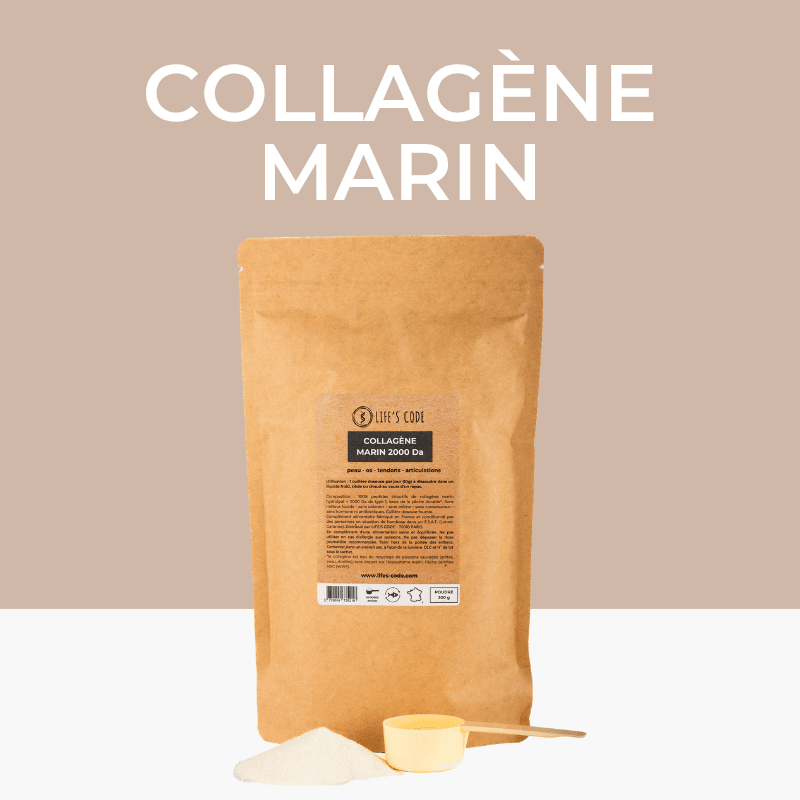
Hydrolyzed marine collagen type 1 - peptides 2000 daltons

Price range: 29.90 € through 349.90 € or subscribe to save up to 12%
Select options This product has multiple variants. The options may be chosen on the product page

What is marine collagen?

Marine collagen is derived from the skin, bones and scales of fish. This type of collagen is particularly appreciated for its bioavailability high, which means that it is easily absorbed by the human body.

In fact, the body's absorption of marine collagen is similar to that of bovine or porcine collagen. This makes it a preferred option in dietary supplements for its no controversy surrounding traceability in the beef and pork sectors.

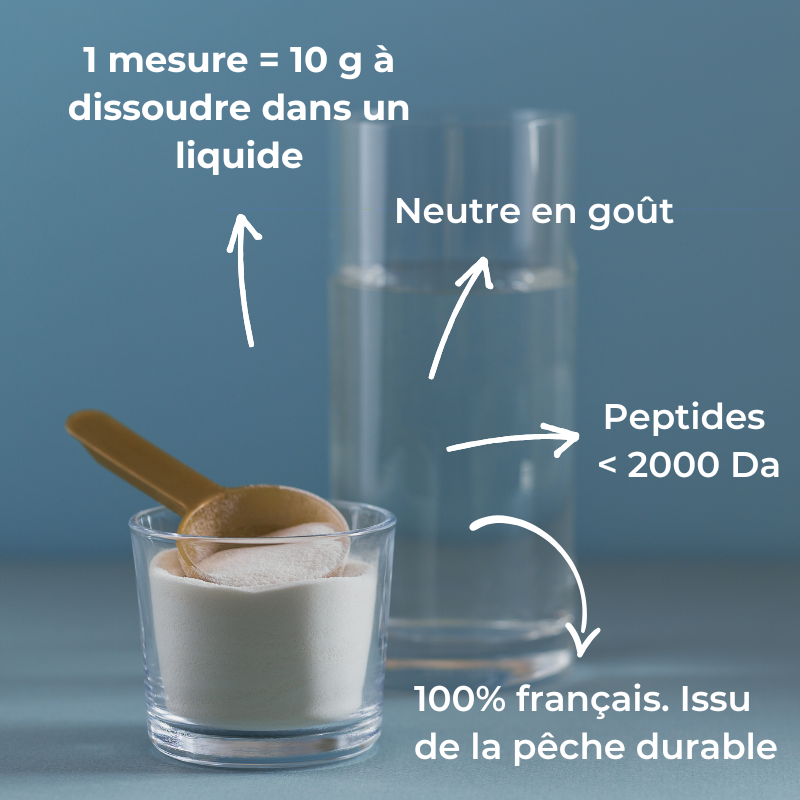
Our marine collagen is a hydrolyzed collagen from 2000 Daltons, an optimal (small) size that facilitates absorption. This allows its peptides to penetrate rapidly into the body blood system and go directly to the tissues where they are needed, such as the skin and joints.

Why choose Life's Code marine collagen?

collagène marin

Purity and safety guaranteed

Our marine collagen is made in Angoulême, Franceguaranteeing a top-quality product with a high total traceability. We are proud to offer a collagen free of heavy metalswithout additives or preservatives.

Proven bioavailability and efficacy

The collagen we use has proven its effectiveness in numerous scientific studies. Thanks to its small size (2000 Daltons), it is easily absorbed and rapidly transported to the areas of our body where it is needed. This makes it a preferred choice for visible and measurable effects on skin, joints and bones.

The benefits of marine collagen

For the skin

Unlike traditional forms of vitamin C, which are partially degraded in the gastrointestinal tract before reaching the bloodstream, the liposomal vitamin C passes directly into cells unaltered. Liposomes play a crucial role in encapsulating vitamin C within a lipid membrane, enabling more complete absorption. According to a study published in the Journal of Nutritional Biochemistry (2013), the liposomal form of vitamin C can offer up to thirty times more vitamin C in the blood compared with conventional shapes.

For joints

Collagen is essential for maintaining healthy joints, because it is a major component of cartilage. Reduced collagen production can lead to joint pain and mobility problems. Marine collagen is particularly beneficial for supporting joints.

Research conducted by Current Medical Research and Opinion have shown that marine collagen supplementation can reduce joint pain in people suffering from degenerative diseases such as osteoarthritis. It also contributes to improve mobility and to prevent pain associated with cartilage wear.

Support for bones and muscle mass

Collagen is not only useful for skin and joints, it also plays a key role in bone health. In fact, it forms an important part of bone structure. A study in the Journal of Bone and Mineral Research has demonstrated that marine collagen supplementation can increase bone mineral density.This is particularly useful for the elderly or those suffering from fractures.

Marine collagen can also help to repair muscle tissue after intense physical effort. It promotes recovery and strengthens muscle mass, especially for athletes.

How to choose the right collagen?

There are many types of collagen on the dietary supplement market.

To make an informed choice, it is important to consider several criteria:

Source of collagen

Prefer the marine collagen for its good bioavailability and optimum safety compared to certain bovine or porcine collagens.

Hydrolysis and peptide size

The hydrolyzed collagen presents very small peptides (2000 Daltons), guaranteeing better absorption and increased efficiency.

Purity and craftsmanship

Choose a manufactured collagen additive-free and complying with strict quality standards. The product's origin is also an important criterion, so give preference to locally manufactured products, like ours, for better traceability.

High dosage 

We recommend consuming 10 grams per day of collagen. This is the dose needed to observe any real noticeable effects. Many brands use very good marketing to offer only a few mg of collagen in capsules, banking on consumers' lack of knowledge!

Neutral taste 

Our collagen does not contain no aromas. Its neutral taste makes it easy to add to all your hot or cold drinks.

Scientific studies

Make sure that the collagen you choose is supported by scientific studies. The collagen we have selected benefits from extensive clinical research attesting to its efficacy and safety.

Directions for use

The standard dosage for marine collagen is generally 5 to 10 grams a daydepending on product concentration and specific user requirements. The dose of 5 grams per day may be sufficient for beneficial effects on skin and joints, while a dose of 10 grams can be considered for faster results or for specific needs, such as joint support or muscle recovery after intense physical effort.

We recommend a daily dose of one measuring spoon, i.e. 10 grams marine collagen for optimum effects.

How to use

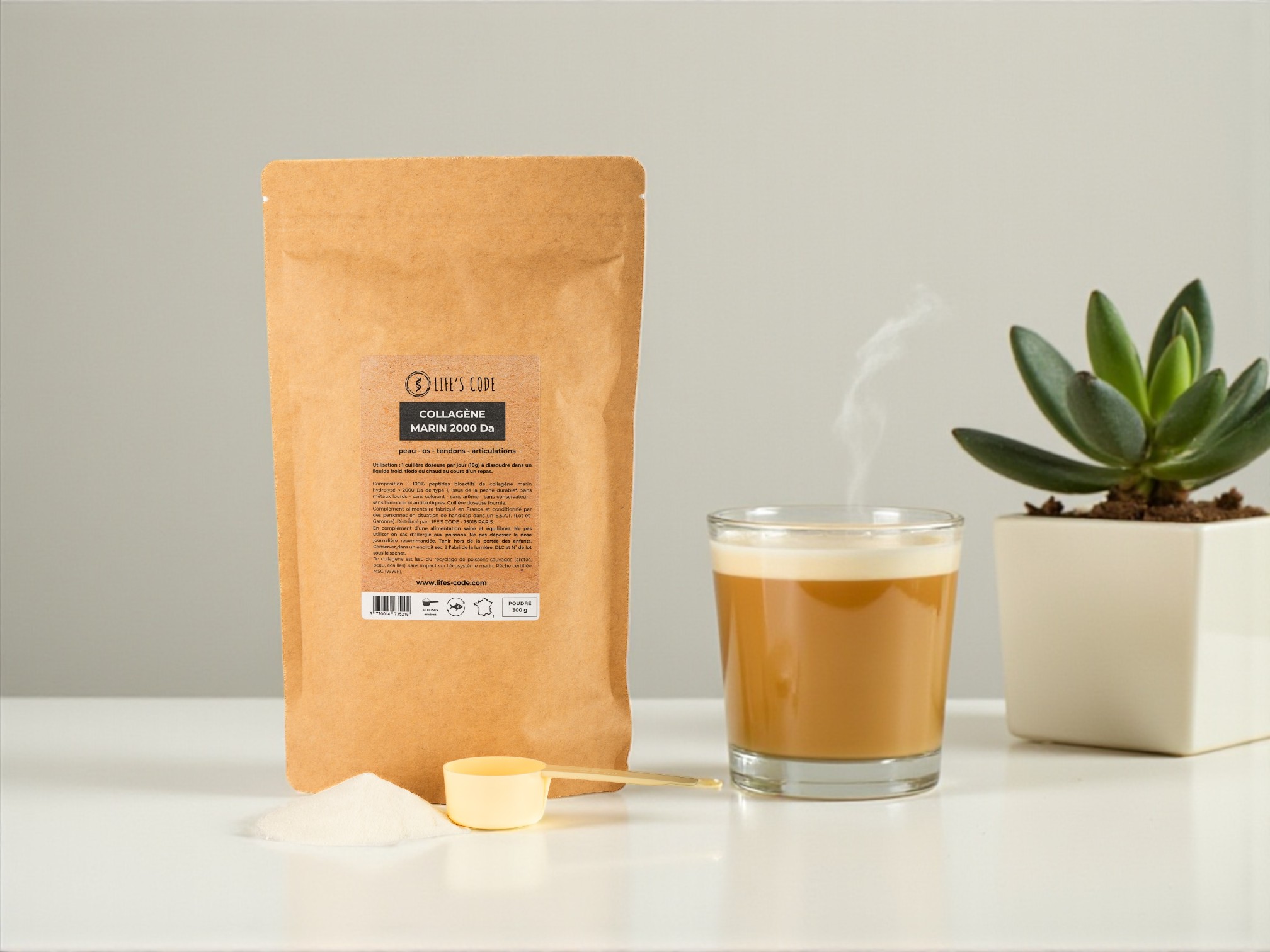
Simply mix the recommended amount (one dose = 10 g) in a glass of water, smoothie or other liquid of your choice, hot or cold.

To enhance the experience, you can add a few drops of lemon to your drink, or pour the powder into a hot vegetable drink, for example.

You can also incorporate collagen into your food preparations (cakes, sauces, etc.) provided you never heat it above 180°C. In fact, its hydrolyzed form makes it highly heat-stable.

Tip: it may be advisable to take collagen powder on an empty stomach or 30 minutes before or after a meal and/or combine it with vitamin C to maximize its absorption.

When should I take marine collagen?

Marine collagen can be taken at any time of day, according to your preferences. However, here are a few tips:

    • The morning: Taking collagen on an empty stomach can optimize its absorption. You can mix it into your morning drink (such as a smoothie or juice) to get the day off to a good start.

    • Before or after exercise: If you're using it for muscle recovery or to support joint health, it's recommended to take collagen after exercise to help repair muscle and joint tissue.

    • In the evening: Collagen can also be taken before bedtime, as the body regenerates during sleep and uses the nutrients to repair and strengthen skin and joints.

Usage period

The results of marine collagen can be seen after approximately 4 to 6 weeks of daily use, although positive effects can be seen as early as the first few weeks, particularly in terms of skin hydration and elasticity.

For long-lasting effects, we recommend taking marine collagen over a prolonged period of time: 3 monthsthen take a break or continue at a lower maintenance dose, depending on your needs.

Precautions and advice

    • Do not exceed the recommended daily dose.

    • If you are pregnant, breast-feeding or have any special medical conditions, please consult your health care professional before using dietary supplements.

    • Marine collagen is generally well tolerated, but if you have an allergy to marine products, it's best to choose another type of collagen (such as bovine or porcine).

Dietary supplements should not be used as a substitute for a varied and balanced diet and a healthy lifestyle. If in doubt about a medical treatment, consult a health professional before using this product.

FAQ - Marine collagen

What is collagen?

The collagen is a structural protein representing approximately 30% of total protein in the human body. It is mainly found in connective tissue, skin, bones, tendons and ligaments.

Endogenous collagen (synthesized by the body) plays a key role in the production of collagen a key role in the structure, strength, and elasticity of tissuesThis helps maintain the body's firmness and suppleness.

The collagen endogenous (synthesized by the body) is essential for maintain the structure and integrity of body tissues. It brings skin support and elasticity, strengthens bones, tendons and ligamentswhile contributing to the joint health and cartilages.

There are several types of collagen, each having a specific role in the body:

Type I The most abundant, present in the skin, bones, tendons and ligaments.
Type II Essential for cartilage health and joints.
Type III : Found in the elastic fabrics and blood vessel walls.
Type IV Located in the basal cell membranesplaying a key role in tissue support.
Type V Present in hair and the cell surface.

This is about type I collagen.

The collagen naturally produced by the body (endogenous collagen) plays a fundamental role in several structures:

💆‍♀️ Skin It maintains theelasticity and thehydrationhelping to reduce wrinkles and preserve your skin firm and supple.
🦴 Bones It is the organic matrix bonesbringing them strength and flexibility.
🦵 Joints Present in the cartilageit contributes to theshock absorption and promotes joint mobility.

With age, collagen production declines, which can have an impact on skin, joints and bone strength.

The collagen used in supplements comes mainly from animal sourcessuch as cattle hides, chicken bones and fish cartilage. 

🔸 What about plant sources?

There is no such thing as plant collagen strictly speaking. However, some plant-based alternatives contain nutrients (vitamin C, amino acids, silicon) which naturally stimulate collagen production by the organization.

Our marine collagen is from animal sources and comes from the recycling of fish skins, scales and bones. These fish are not caught specifically for collagen production, but for food. What's more, they are MSC (Marine Stewardship Councilsustainable fishing label), guaranteeing responsible management of marine resources.

What are the main benefits of collagen for the skin?

The collagen can boost hydration of your skin, reduce the appearance of wrinklesimprove your elasticity and give it a smoother, firmer appearance.

* de Miranda RB et al. Effects of hydrolyzed collagen supplementation on skin aging: a systematic review and meta-analysis. Int J Dermatol. 2021 Dec;60(12):1449-1461.

* Pu SY et al. Effects of Oral Collagen for Skin Anti-Aging: A Systematic Review and Meta-Analysis. Nutrients. 2023 Apr 26;15(9):2080.

Yes, several studies* have shown that collagen supplements can improve’appearance of wrinkles and increase the’skin elasticity. However, results may vary from person to person.

* de Miranda RB et al. Effects of hydrolyzed collagen supplementation on skin aging: a systematic review and meta-analysis. Int J Dermatol. 2021 Dec;60(12):1449-1461.

* Pu SY et al. Effects of Oral Collagen for Skin Anti-Aging: A Systematic Review and Meta-Analysis. Nutrients. 2023 Apr 26;15(9):2080.

Collagen plays a key role in maintaining’cartilage integrity. It can help reduce joint pain and improve joint mobility.

Khatri M et al. The effects of collagen peptide supplementation on body composition, collagen synthesis, and recovery from joint injury and exercise: a systematic review. Amino Acids. 2021 Oct;53(10):1493-1506. doi: 10.1007/s00726-021-03072-x. 

Collagen can stimulate hair growth and strengthen nails by providing the amino acids essential for their formation.

* Hwang SB et al. Hair-Growth-Promoting Effects of the Fish Collagen Peptide in Human Dermal Papilla Cells and C57BL/6 Mice Modulating Wnt/β-Catenin and BMP Signaling Pathways. Int J Mol Sci. 2022 Oct 7;23(19):11904. doi: 10.3390/ijms231911904.

* Hexsel D et al. Oral supplementation with specific bioactive collagen peptides improves nail growth and reduces symptoms of brittle nails. J Cosmet Dermatol. 2017 Dec;16(4):520-526. doi: 10.1111/jocd.12393. 

Collagen can stimulate hair growth and strengthen nails by providing the amino acids essential for their formation.

* Hwang SB et al. Hair-Growth-Promoting Effects of the Fish Collagen Peptide in Human Dermal Papilla Cells and C57BL/6 Mice Modulating Wnt/β-Catenin and BMP Signaling Pathways. Int J Mol Sci. 2022 Oct 7;23(19):11904. doi: 10.3390/ijms231911904.

* Hexsel D et al. Oral supplementation with specific bioactive collagen peptides improves nail growth and reduces symptoms of brittle nails. J Cosmet Dermatol. 2017 Dec;16(4):520-526. doi: 10.1111/jocd.12393. 

Results may vary from person to person, but Notable improvements are often observed after 4 to 8 weeks of regular use, depending on the individual and the collagen formulations.

What is the recommended daily dose of collagen?

Common doses of collagen vary between 2.5 and 15 grams per daydepending on individual needs and collagen type. At Life's Code®, we recommend a daily dose of 10 grams for optimum results.

Collagen can be taken with or without meals. Although some experts suggest it is better absorbed on an empty stomach, evidence for this remains limited.

In general, the collagen has no’major interactions with drugs or supplements. However, it is always preferable to consult a health professional to avoid any potential interaction.

What forms of collagen are available (powder, capsules, liquid)?

Collagen is found in different forms: powder, capsules, tablets and liquid, each with its own advantages in terms of absorption and practicality. However, it is crucial to take a sufficient dose to obtain good results. Capsules or tablets often contain lower doses of collagen, what can make it difficult to reach the optimal amount. This is why we recommend formats that make it easy to consume 5 to 10 grams of collagen per day. Life's Code® marine collagen is in powder form.

Non-hydrolyzed collagenin its native form, is a a larger, more complex molecule, making it more difficult to assimilate. It is generally used in topical or dietary applications. On the other hand, hydrolyzed collagen is broken down into smaller peptides for easier absorption by the organism and improves its effectiveness.

How is collagen absorbed by the body?

Studies show that hydrolyzed forms, whether they are liquid or powderare generally well absorbed. The powder form is particularly appreciated for its flexibility in preparation, its stability long-term (with a 5-year shelf life!) and easy dosageoffering a practical, sustainable solution.

Yes, thanks to its hydrolyzed formcollagen is highly bioavailable, which allows for optimal absorption and more efficient use by the body.

Studies show that hydrolyzed forms, whether they are liquid or powderare generally well absorbed. The powder form is particularly appreciated for its flexibility in preparation, its stability long-term (with a 5-year shelf life!) and easy dosageoffering a practical, sustainable solution.

What are the possible side effects of collagen?

Visit side effects are rarebut can include mild digestive problems such as bloating or nausea. In the event of digestive problems, it is advisable to reduce the dose and/or consult a healthcare professional. People with seafood allergies should be cautious and refrain from taking this supplement.

Yes, our collagen comes from fish. People allergic to fish should therefore avoid consuming marine collagen. Possible allergic reactions may include swelling, rash or itching. In such cases, it's important to consult a doctor.

Collagen is generally well tolerated. However, the following points should be borne in mind, Life's Code® collagen is of marine origin and is contraindicated for individuals with fish and shellfish allergies.. For any other specific medical condition, it is recommended to consult a physician before starting any supplement.

How to choose good quality collagen?

If you would like to contact us, please call our customer service department on phone at 07.80.90.62.80 or by mail to mail@lifes-code.com.

Choose products containing hydrolyzed collagen less than 5000 daltons in sizeThis promotes better absorption. Also make sure that the source of collagen (cattle, fish, etc.) or clearly indicatedand check the levels of potential contaminants. Opt for certified productswith tests carried out by third-party laboratories to guarantee their quality and purity.

Food supplements, including collagen, are subject to strict regulations, but these vary from country to country. Unlike medicines, they are considered food products and must meet specific safety standards.

But not all products are created equal! Quality and effectiveness may differ from one brand to another. At Life's Code®, we make it a point of honor to offer you collagen of exceptional purity, tested and guaranteed for your well-being.

Is collagen produced ethically and sustainably?

Collagen production can vary in terms of durability and ethics. Some manufacturers favor responsible sources and environmentally-friendly processes, while others do not adopt these best practices.

At Life's Code®, respect for nature is at the heart of our commitments. Our collagen comes from sustainable fishing, MSC-certifiedand is extracted from fish skins, bones and scales, in an eco-responsible approach.

To date, collagen is a protein exclusively of animal origin. So there's no such thing as true vegan collagen.

However, some vegetarian and vegan alternatives can support natural collagen production by the organism. These include vitamin C, vitamin E and plant extracts such as siliconwhich play a key role in collagen synthesis.

How does collagen compare with other skin supplements such as vitamins C and E?

The vitamin C plays a key role in the collagen synthesis. For its part, the vitamin E acts as a powerful antioxidantprotecting the skin from external aggression and oxidative stress.

Combined with collagen, these nutrients form an ideal alliance for healthier, suppler, stronger skin.

The collagen acts on the skin structure  while the’hyaluronic acid plays a key role in the’hydration. Together, they form an ideal combination for the skin. For example, For optimal results, we recommend pairing Phyco-Sublime (containing hyaluronic acid) to your collagen intake.

Is collagen good for athletes and active people?

Yes! collagen plays a key role in the joint functionby helping to strengthen tendons and ligaments, which are particularly strained during intense effort. It can also reduce pain and promote muscle recoverymaking it a valuable ally for athletes.

* Khatri M. et al. The effects of collagen peptide supplementation on body composition, collagen synthesis, and recovery from joint injury and exercise: a systematic review. Amino Acids. 2021 Oct;53(10):1493-1506. 

Yes! collagen plays an essential role in the connective tissue regenerationto promote optimal healing. It helps speed recovery from injury or surgery by providing tissues with the elements they need to rebuild.

de Souza A et al. Fish collagen for skin wound healing: a systematic review in experimental animal studies. Cell Tissue Res. 2022 Jun;388(3):489-502. 

Life's Code® collagen is ideal for seniors. Indeed, type I collagen is recommended for support skin and bone function. Its shape hydrolyzed also makes it easier to digest and absorbThey provide optimum support for your body.

In general, the collagen is Considered safe during pregnancy and breastfeeding. However, it is always advisable to consult a health professional before starting any supplement, to ensure it is suitable for your situation.

In general, the collagen is Considered safe during pregnancy and breastfeeding. However, it is always advisable to consult a health professional before starting any supplement, to ensure it is suitable for your situation.

Our selection of marine collagen products

Hydrolyzed marine collagen type 1 - peptides 2000 daltons

Price range: 29.90 € through 349.90 € or subscribe to save up to 12%
Select options This product has multiple variants. The options may be chosen on the product page

Joint Comfort Pack: Phyco-Sublime + Marine Collagen 2000 Da type 1

Price range: 84.90 € through 224.90 € or subscribe to save up to 12%
Select options This product has multiple variants. The options may be chosen on the product page

Bibliography

Studies on collagen and skin health

1

Borumand, M., & Sibilla, S. (2014). "Effect of hydrolyzed collagen supplementation on the skin aging process: A systematic review of clinical trials." *Journal of Cosmetic Dermatology*, 13(2), 132-140.

Systematic review of clinical trials on the effects of hydrolyzed collagen on skin aging.

2

Proksch, E., et al. (2014). "Oral intake of specific bioactive collagen peptides reduces skin wrinkles and increases skin elasticity." *Journal of Dermatological Treatment*, 25(4), 276-281.

Study showing that oral intake of specific collagen peptides improves skin elasticity and reduces wrinkles.

Studies on collagen and joints

3

Moskowitz, R. W. (2000), "Role of collagen hydrolysate in maintaining joint health." *Current Medical Research and Opinion*, 16(6), 603-608.

Study on the role of hydrolyzed collagen in joint health.

4

Vázquez, J. A., et al. (2012). "Effect of collagen hydrolysate on joint pain and joint health." *Journal of Clinical Rheumatology*, 18(4), 217-223.

Research into the effects of hydrolyzed collagen on joint pain and joint health.

5

Zhang, R., et al. (2015). "Collagen peptide supplementation for knee osteoarthritis: A systematic review and meta-analysis." *Osteoarthritis and Cartilage*, 23(5), 795-803.

Systematic review and meta-analysis on the efficacy of collagen peptides for knee osteoarthritis.

6

Zhang, R., et al. (2015). "Collagen peptide supplementation for knee osteoarthritis: A systematic review and meta-analysis." *Osteoarthritis and Cartilage*, 23(5), 795-803.

Systematic review and meta-analysis on the efficacy of collagen peptides for knee osteoarthritis.

Collagen and bone studies

7

König, D., et al. (2018). "Effects of collagen peptide supplementation on bone health in postmenopausal women: A randomized controlled trial." *Journal of Bone and Mineral Research*, 33(2), 373-381.

Randomized controlled trial of the effects of collagen peptides on bone health in postmenopausal women.

8

Saito, M., et al. (2013). "Collagen peptide supplementation improves bone mineral density and bone metabolism in postmenopausal women." *Bone*, 55(1), 206-211.

Study on the effects of collagen peptide supplementation on bone mineral density and bone metabolism in postmenopausal women.

Studies on collagen bioavailability and digestibility

9

Schilling, J. A., et al. (2013). "Bioavailability and pharmacokinetics of orally ingested collagen peptides: A review of the literature." *Journal of Nutritional Biochemistry*, 24(10), 1560-1570.

Review of studies on the bioavailability and pharmacokinetics of orally ingested collagen peptides.

10

Cruz, S. A., et al. (2015). "Collagen peptides are absorbed in their intact form and accumulated in the skin: A pilot study." *Journal of Dermatological Science*, 79(2), 183-189.

Pilot study showing that collagen peptides are absorbed in their intact form and accumulate in the skin.

Studies on the effects of collagen on muscle recovery and performance

11

Zdzieblik, D., et al. (2015). "Collagen peptide supplementation during resistance training in older adults: A randomized controlled trial." *Journal of the American College of Nutrition*, 34(6), 479-488.

Randomized controlled trial of collagen peptide supplementation during resistance training in older adults.

12

Tsuji, T., et al. (2016). "Effects of collagen peptides on exercise-induced muscle damage: A double-blind, placebo-controlled study." *Journal of Sports Science and Medicine*, 15(4), 644-651.

Double-blind controlled study on the effects of collagen peptides on exercise-induced muscle damage.

Studies on Medical and Aesthetic Applications

13

Takiguchi, M., et al. (2017). "Collagen peptide supplementation for wound healing and scar formation: A clinical trial." *Wound Repair and Regeneration*, 25(4), 583-591.

Clinical trial on the effects of collagen peptide supplementation on wound healing and scar formation.

14

Rivière, P., et al. (2012). "Effect of collagen supplementation on skin hydration and elasticity: A pilot study in patients with atopic dermatitis." *Clinical, Cosmetic and Investigational Dermatology*, 5, 1-8.

Pilot study on the effect of collagen supplementation on skin hydration and elasticity in patients with atopic dermatitis.